

The short version
- Facial volume loss is not only fat thinning out.
- The fat pads of the face shrink and shift downward, the underlying bone changes shape, and the skin loses the elasticity that held everything in place.
- Fillers replace lost volume where the cause is deflation.
- They do not treat laxity or skin quality.
What is happening underneath is a normal set of anatomical changes, not a problem that has to be fixed. Understanding them is still useful, because volume loss, sagging and skin quality are three different processes that look similar from the outside and respond to entirely different treatments. This guide covers what changes, why the midface shows it earliest, how to tell the processes apart, and what a filler can and cannot do about any of it.
What Actually Changes: Fat, Bone and Skin
Volume loss is usually described as fat disappearing, which is only part of the story. Three layers change at once, and each contributes something different to what you see in the mirror.
The fat pads
Facial fat is not a single continuous layer. Research published in Plastic and Reconstructive Surgery in 2007 by Rohrich and Pessa described the face as containing discrete fat compartments separated by connective tissue, arranged in deep and superficial layers. Those compartments do not age uniformly. Some thin out, others descend, and because they are separate rather than continuous, the boundaries between a deflated compartment and a fuller one become visible as a shadow or a step.
The bone underneath
The facial skeleton is not fixed after growth finishes. Imaging studies of facial aging have documented gradual resorption, particularly around the eye socket rim, the midface and the jawline. Since the soft tissue drapes over that framework, a smaller framework means less support for the same amount of skin. This is the layer most people never consider and the reason surface treatments sometimes underdeliver.
The skin
Collagen and elastin decline with age and with cumulative sun exposure, which in Central Florida is a meaningful factor year round. Skin that has lost elasticity no longer retracts over a smaller foundation, so the same volume change reads as looseness rather than just flatness. Skin quality is its own treatment category and is addressed by skin remodeling rather than by adding volume.
Why the Midface Shows It First
The cheek area tends to be the earliest and most noticeable location, and there are structural reasons for that rather than coincidence.
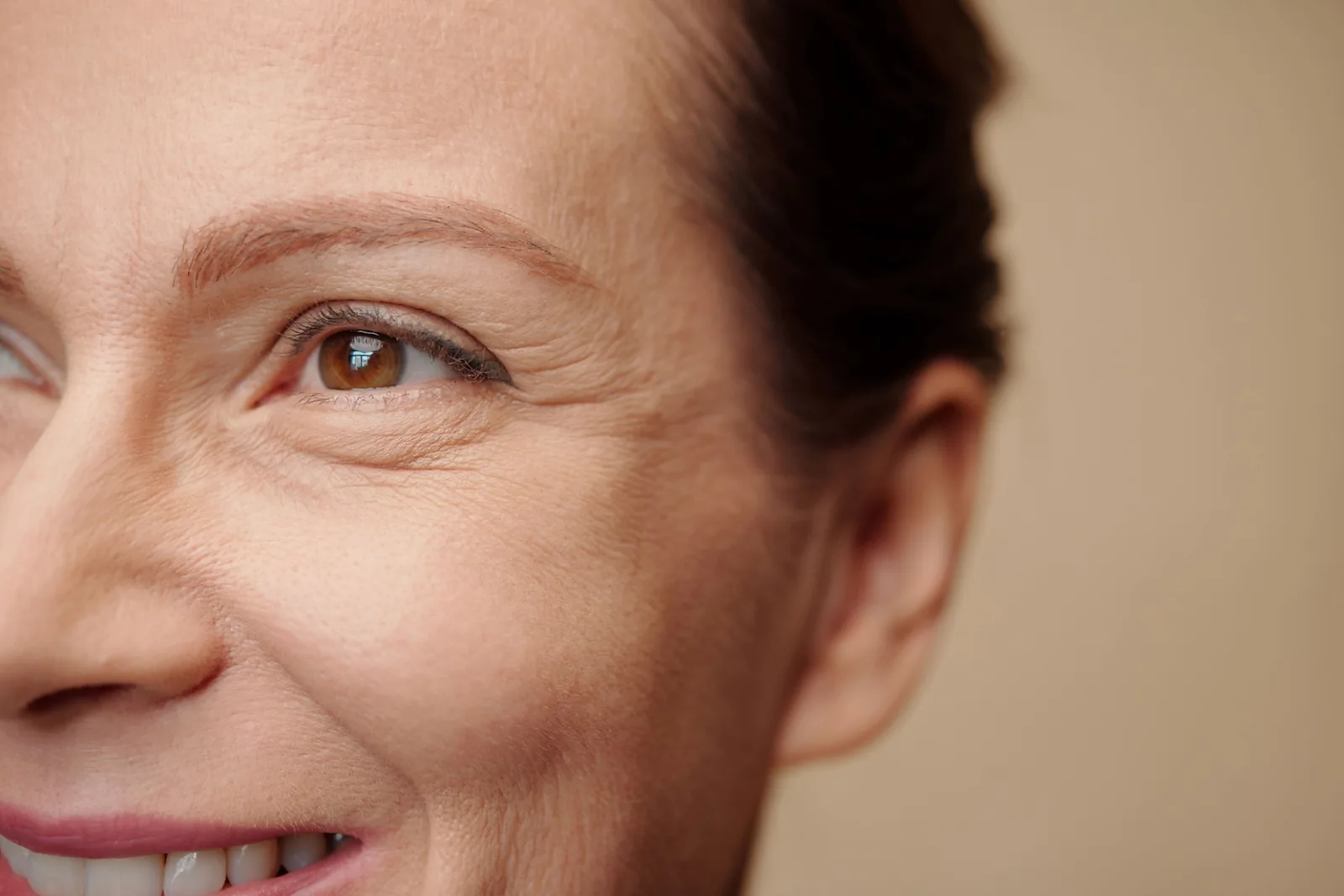
The midface carries some of the largest and most mobile fat compartments, sitting over bone that is among the first to change. It is also the area doing the most work against gravity, since everything below it is partially supported by what sits above. When midface support diminishes, the effects show up in places away from the cheek itself: the nasolabial fold deepens because tissue has descended into it, the under eye area looks hollow because the boundary between the lower lid and the cheek becomes visible, and the jawline softens as tissue migrates downward.
This is why experienced injectors often address the midface when the complaint is about a fold or a shadow somewhere else. Treating the fold directly can fill a crease while leaving the reason it formed untouched. Which structures get addressed and in what order is the substance of a planning conversation with the clinical team.
Volume Loss vs. Sagging: How to Tell Them Apart
These two get used interchangeably and they are not the same thing. Getting the distinction right is what determines whether a treatment will do anything for you.
A useful home test: look in the mirror sitting upright, then lie back and look again. Tissue that redistributes noticeably when you lie down is being affected by gravity and laxity. Contours that look the same in both positions but flatter than they used to are deflation. Most people over a certain age have some of each, in different proportions in different zones of the face.
The reason it matters is that adding volume to a face whose primary issue is laxity produces a heavy, overfilled look rather than a restored one. That outcome is one of the more common complaints about injectable treatment, and it usually traces back to treating the wrong mechanism rather than to the product itself.
What Fillers Address, and What They Do Not
Dermal fillers replace volume where volume has been lost. The FDA has approved certain hyaluronic acid fillers specifically for cheek augmentation to correct age related midface volume loss in adults, which is precisely the mechanism described above. Placed in the right plane and the right compartment, they restore projection and support, and because hyaluronic acid is reversible, there is a correction pathway if the result is not what was intended. Fillers sit within the broader set of treatments available rather than being the answer to every concern.
What they do not do is lift loose skin, improve texture, change pigmentation, or tighten muscle. They are also temporary, since hyaluronic acid is gradually broken down by the body, and the duration varies with the product used, the area treated and individual metabolism. Anyone describing filler results as lasting indefinitely is describing something other than what the material does.
One safety note worth stating plainly. Injectable treatment near the facial vasculature carries real risks, including vascular complications, which is why the training and anatomical knowledge of the person holding the syringe matters more than the brand of product. Ask who is injecting and what their background is before you book anywhere.
Where Muscle and Skin Treatments Fit
Volume is one of three levers. Muscle is the second: facial muscles contribute to both expression lines and to the support structure of the face, and treatments that act on muscle address a different problem than filling. Emface works on that layer, and the distinction between muscle focused and injectable approaches is laid out in our comparison of Emface and Botox.
Skin quality is the third. Texture, density and hydration are not volume problems and do not improve because volume was replaced underneath them. A plan that addresses only one of the three levers tends to produce a partial result, which is usually the explanation when someone says the treatment did not do much.
None of this means everyone needs all three, or any of them. Facial aging is not a medical condition, and choosing to do nothing about it is a complete answer. The point of understanding the mechanisms is to make the choice an informed one rather than a reaction to a photograph.
Not sure whether what you are seeing is deflation, laxity or skin quality? Call (689) 282-5599 or schedule a consultation and we will assess all three before recommending anything.
Frequently asked questions
At what age does facial volume loss start?
Can facial volume loss be reversed without fillers?
How long do fillers for volume loss last?
Will fillers make my face look puffy?
Is losing facial volume a health problem?
Can weight loss cause facial volume loss?
Medical note. This article is educational and is not a substitute for professional medical advice, diagnosis or treatment. Emface, Exion and injectable treatments are not appropriate for everyone, and individual results vary. Suitability, session counts and expected outcomes can only be determined during an in-person evaluation of your health history and facial anatomy.